F1 2026 Grid: Every Team and Driver Explained
The complete F1 2026 grid: all 11 teams, 22 race seats, new engine regulations, Cadillac's arrival and Audi's rebrand. Career context for every driver.
- The 2026 grid has 11 teams and 22 seats: Cadillac joins as a new constructor and the former Sauber entry becomes the Audi works team.
- New rules everywhere: power units with up to 350 kW of electrical power (versus 120 kW before), no MGU-H, fully sustainable fuel, and active aerodynamics replacing DRS.
- History says reset years shuffle the order: Brawn 2009, Mercedes 2014 and Red Bull 2022 all won by reading new rules best.
- The engine supplier map (Mercedes powers 4 teams, Ferrari 3, Red Bull Ford 2, Honda 1, Audi 1) may predict 2026 better than the 2025 standings.
- Four drivers aged 21 or under share the grid with Alonso (44) and Hamilton (41): a genuine generational handover.
The 2026 Formula 1 grid is the biggest structural change the sport has seen in a decade. Eleven teams and twenty-two race seats line up under an entirely new engine formula, with Cadillac joining as a brand-new constructor and Audi taking over the entry formerly known as Sauber. If you stepped away from F1 for even one season, half the grid map in your head is now out of date.
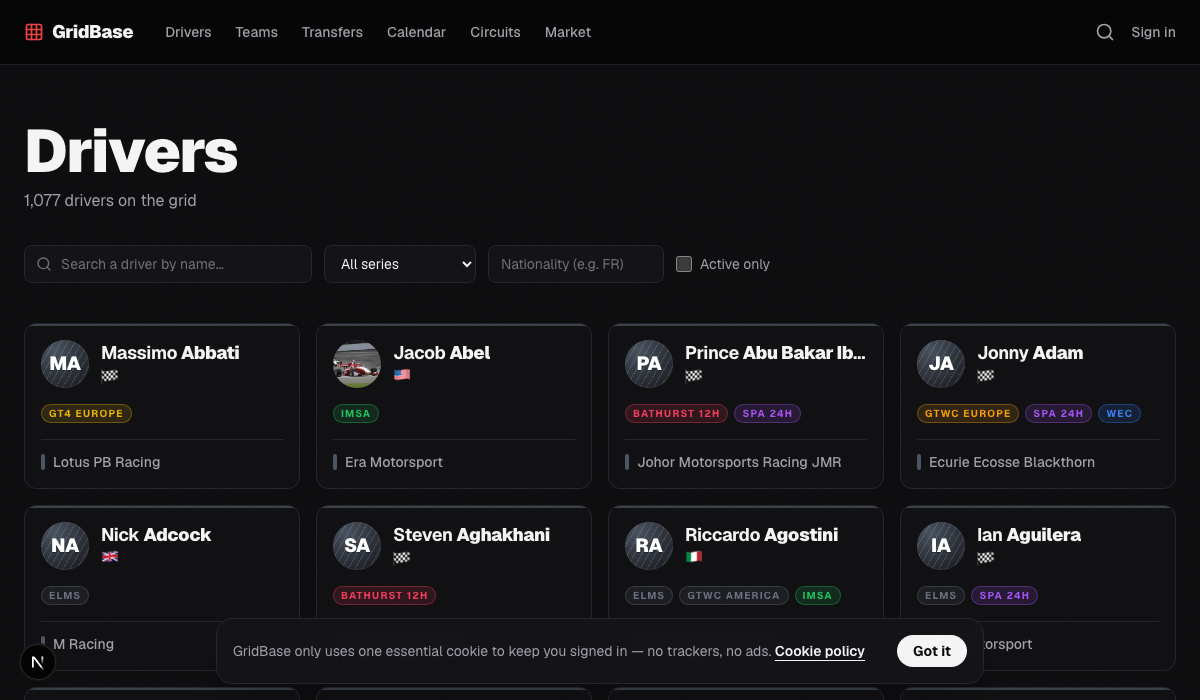
This guide walks through every team and every driver on the 2026 grid, explains why the regulation reset matters so much this year, and gives you the career context behind each name, all backed by the GridBase driver database, where you can dig into any career season by season.
Why 2026 is a reset year
Formula 1 works in regulatory cycles. Within a cycle, the team that nails the first year tends to stay ahead, because development converges while everyone copies the leader. When the rulebook resets, the order can be shuffled violently. Brawn in 2009 and Mercedes in 2014 are the canonical examples of a reset handing dominance to whoever read the new rules best.
The 2026 reset is unusually deep because it touches both chassis and power unit at the same time:
- New power units. The 2026 engines keep the V6 hybrid concept but roughly triple the electrical power contribution, running on fully sustainable fuels. The MGU-H, the most exotic and expensive part of the old formula, is gone.
- New chassis rules. Cars are slightly smaller and lighter, with active aerodynamics replacing DRS as the overtaking aid.
- New manufacturers. Audi arrives as a full works team, Ford returns in partnership with Red Bull Powertrains, and Cadillac (General Motors) enters as the eleventh team.
The practical consequence: pre-season form guides are close to worthless in 2026. A team that ended 2025 at the back could genuinely start 2026 at the front if its engine partner got the new formula right. That uncertainty is exactly what makes this grid guide worth reading carefully, and what makes the fantasy driver market so volatile this season.
The 2026 F1 grid at a glance
| Team | Drivers | 2025 form | 2026 outlook |
|---|---|---|---|
| McLaren | Lando Norris, Oscar Piastri | Champions | Title favourites |
| Ferrari | Charles Leclerc, Lewis Hamilton | Front-runners | Title contenders |
| Red Bull Racing | Max Verstappen, Isack Hadjar | Front-runners | Title contenders |
| Mercedes | George Russell, Andrea Kimi Antonelli | Podium regulars | Dark horse |
| Aston Martin | Fernando Alonso, Lance Stroll | Midfield | The wildcard |
| Williams | Alexander Albon, Carlos Sainz | Midfield leaders | Points regulars |
| Racing Bulls | Liam Lawson, Arvid Lindblad | Midfield | Points regulars |
| Haas | Esteban Ocon, Oliver Bearman | Midfield | Points regulars |
| Alpine | Pierre Gasly, Franco Colapinto | Struggling | Rebuilding |
| Audi | Nico Hülkenberg, Gabriel Bortoleto | New works era | Unknown |
| Cadillac | Sergio Pérez, Valtteri Bottas | New entrant | Learning year |
Twenty-two seats, eleven garages, and at least three teams whose realistic ceiling is anyone’s guess. Let’s go through them one by one.
McLaren: the champions defending under new rules
McLaren enter 2026 as the reigning benchmark, having dominated the final seasons of the old regulations. Their driver pairing is the envy of the pit lane: Lando Norris and Oscar Piastri are both champions in their prime, both deeply embedded in the team, and both quick enough that neither can relax.
Norris has matured from the sport’s favourite nearly-man into a ruthless title winner. His qualifying pace was always elite; what changed was the racecraft under pressure. Piastri, meanwhile, might be the most unflappable driver of his generation, his title-winning campaigns were built on a near-total absence of unforced errors.
The open question is whether McLaren’s aerodynamic excellence translates to the new active-aero formula, and whether Mercedes power remains the reference under the 2026 engine rules. If both hold, the rest of the grid is racing for third. You can follow both drivers’ full careers, junior titles included, on their GridBase profiles.
Ferrari: Hamilton, Leclerc and the weight of expectation
Ferrari’s line-up needs no introduction: Charles Leclerc, the fastest one-lap driver of his era over a single flying lap, and Lewis Hamilton, the most decorated driver in the sport’s history with seven world titles. Hamilton’s move to Maranello was the transfer story of the decade (we covered how these deals actually work in our guide to F1 driver transfers), and 2026 is the season the project was always aimed at.
The logic was simple: don’t judge the partnership under the old rules, judge it when the slate is wiped clean. That moment has arrived. Ferrari’s engine department has historically excelled at regulation resets, the 2026 power unit is the company’s chance to convert years of hybrid experience into a definitive advantage.
Leclerc remains the internal reference on Saturdays. Hamilton brings something no other driver on the grid has: first-hand memory of what winning a regulation reset feels like from inside the team that did it. If Ferrari give these two a car, the championship maths gets crowded very quickly.
Red Bull Racing: Verstappen and the boldest promotion in years
Max Verstappen starts 2026 with four world championships and the status of the grid’s most complete driver. Whatever the car does, he extracts its maximum, the question at Red Bull is never Verstappen, it’s everything around him.
That includes the second seat, where Red Bull have made their trademark aggressive call: Isack Hadjar, promoted from Racing Bulls after a rookie season that impressed the right people. The Frenchman is quick, confident and combative; he is also stepping into the most scrutinised seat in Formula 1, one that has chewed through more experienced drivers than him.
The bigger unknown sits behind the cockpit: 2026 is the first season of Red Bull Powertrains’ own engine, built in partnership with Ford. Building a Formula 1 power unit from scratch is among the hardest engineering projects in sport. If it works, Verstappen is a title threat as always. If it doesn’t, 2026 becomes a very long year in Milton Keynes.
Mercedes: the young line-up with reset pedigree
Mercedes enter the new era with George Russell as team leader and Andrea Kimi Antonelli in year two of the most-hyped Mercedes youth promotion since Hamilton himself. Russell has quietly become one of the most complete drivers on the grid, brutally fast in qualifying, forensic with feedback, and a two-time title contender on merit.
Antonelli’s rookie season delivered exactly what a rookie season should: speed, mistakes, and unmistakable signs of something special. The Italian is the long-term project; 2026 tells us how long “long-term” needs to be.
History is the reason nobody discounts Mercedes: the last time the engine formula changed this radically, in 2014, Mercedes built an advantage that lasted eight consecutive constructors’ titles. The engine division in Brixworth has been pointed at 2026 for years. Dark horse is almost underselling it.
Aston Martin: the Newey wildcard
Aston Martin are 2026’s great unknown, and the reason has a name: Adrian Newey. The most successful car designer in Formula 1 history joined the team specifically for this regulation reset, with Honda works power arriving alongside him. Newey’s career is essentially a list of regulation changes he read better than everyone else.
In the cockpit, Fernando Alonso, two world titles, and at 44 still setting the internal benchmark, has extended his career precisely for this car. Few careers in the GridBase database span as many eras or as many comebacks. Alongside him, Lance Stroll continues as the team’s known quantity.
Nobody outside the factory knows if the AMR26 is a masterpiece. That’s the point of a wildcard. If it is, the 2026 season gets a third title protagonist nobody’s model predicted.
Williams: the revival gets serious
Williams’ long rebuild under James Vowles produced its first real fruit in 2025, when the team led the midfield. For 2026 the line-up is genuinely strong: Alexander Albon, whose stock has never been higher, and Carlos Sainz, a multiple grand prix winner who chose Grove as the place to bet his prime years on the new rules.
Sainz’s arrival matters beyond raw pace. He has driven for Ferrari, McLaren and Red Bull’s programme, he knows what front-running organisations feel like from inside, and that calibration is exactly what a rising team needs. With Mercedes power and two proven race drivers, Williams’ target is clear: keep the best-of-the-rest crown, and ambush the podium places when the big teams stumble.
Racing Bulls: the junior team’s strongest hand
Red Bull’s second team fields Liam Lawson and Arvid Lindblad, one driver with something to prove, one with everything to prove. Lawson has survived the Red Bull programme’s brutal internal competition and emerged as a dependable, aggressive racer. Lindblad is the newest product of the pipeline, a British teenager promoted on the strength of rapid junior results (the path we map in detail in F2 and F3 explained).
The team’s role hasn’t changed: score points, develop drivers, and answer the only question Red Bull management ever asks, who deserves the senior seat next?
Haas: quietly the most experienced midfield pairing
Haas enter 2026 with a pairing that mixes grit and youth: Esteban Ocon, a grand prix winner with a decade of front-line experience, and Oliver Bearman, the Ferrari academy graduate whose stand-in performances made his promotion inevitable. Ocon gives Haas a hardened reference driver; Bearman gives them a future. With Ferrari power under the new rules, the American team’s ceiling depends heavily on Maranello’s engine, which, in 2026, might be no bad thing.
Alpine: rebuilding around Gasly
Alpine’s turbulent years have left Pierre Gasly as the anchor, a race winner and consistent points scorer who has carried the project through its churn. Alongside him, Franco Colapinto brings South American fire and the backing of a continent that hasn’t had a full-time F1 hero in a generation. Alpine’s 2026 gamble is the switch to customer Mercedes power: give the team a known-quantity engine and let the chassis department stand or fall on its own work.
Audi: the new works team
The entry that raced as Sauber is now Audi’s full factory team, the German giant’s first Formula 1 works programme. Audi arrives with enormous resources, a purpose-built power unit, and a completely realistic understanding that new manufacturers rarely win early.
The driver pairing is built for exactly that situation. Nico Hülkenberg, the grid’s great survivor, finally took his first podium in the twilight of the old rules and brings two decades of development experience. Gabriel Bortoleto arrives with back-to-back junior titles and a reputation as Brazil’s best prospect since the Senna era. One driver to build the car, one to build the future.
Cadillac: the eleventh team
For the first time since 2016, Formula 1 has a brand-new constructor. Cadillac’s entry gives the grid its eleventh team and General Motors its long-sought F1 presence. The driver strategy is the opposite of Audi’s youth bet: Sergio Pérez and Valtteri Bottas bring over 500 grand prix starts and more than 100 podiums between them.
For a new team, that experience is the whole point. Expansion teams live or die on the quality of their feedback loop, and there is no substitute for drivers who know exactly what a winning car feels like. Points in year one would be a triumph; the real project is 2028 and beyond, when GM’s own power unit arrives.
How the driver market values the 2026 grid
One of the more entertaining lenses on the new grid is the fantasy motorsport games, where every driver carries a price in GridBase Credits based on titles, team strength, series prestige and career experience, and where prices move daily with popularity and confirmed transfers.
The market’s current hierarchy is broadly what you’d expect: the champions and top-team drivers (Verstappen, Hamilton, Norris, Piastri, Leclerc) sit at the S-tier ceiling, the established midfield names cluster in the B range, and the newcomers at Audi, Cadillac and Alpine offer bargain prices for anyone who believes in an upset. If you think the market has someone wrong, that’s the game. Our fantasy F1 beginner’s guide explains how to turn that opinion into a roster.
What history says about regulation resets
If you want to calibrate your expectations for 2026, the best dataset is the sport’s previous resets. Formula 1 has torn up its technical rulebook a handful of times in the modern era, and the pattern across them is strikingly consistent.
2009, the double-diffuser year. A radical aerodynamic reset was supposed to help overtaking; what it actually did was reward the three teams that spotted a loophole in the diffuser regulations. Brawn GP, a team that had been Honda’s abandoned project months earlier, won both titles with a fraction of the budget of the giants. The lesson: in a reset year, a single clever interpretation can outweigh a hundred million dollars of conventional development.
2014, the hybrid dawn. The switch to V6 turbo-hybrids was the closest analogue to 2026, because the engine was the differentiator. Mercedes had committed early, spent enormously, and built the best power unit by a margin the others needed years to close. The result was the longest period of dominance in the sport’s history: eight consecutive constructors’ championships. The lesson: when the engine formula changes, the best engine wins the era, not just the year.
2022, the ground-effect reset. A chassis-only reset this time, and again the order shuffled: Red Bull read the new aerodynamics best, Mercedes, the outgoing dominator, got it wrong and needed two seasons to recover. Ferrari were quick instantly but couldn’t operationalise their pace. The lesson: reading the rules correctly is necessary but not sufficient; you also have to race well under them.
Apply those lessons to 2026 and you get the honest forecast: the winner of 2026 will probably be a team whose engine partner nailed the new formula, and it may well not be the team that won in 2025. That’s not pundit hedging; it’s the base rate.
The engine map: who runs what in 2026
Because power units are expected to be the differentiator, the supplier map is arguably more predictive than last year’s constructors’ standings. Here’s how the eleven teams divide among the five manufacturers:
| Power unit | Teams supplied |
|---|---|
| Mercedes | Mercedes, McLaren, Williams, Alpine |
| Ferrari | Ferrari, Haas, Cadillac |
| Red Bull Ford | Red Bull Racing, Racing Bulls |
| Honda | Aston Martin |
| Audi | Audi |
Three things jump out of that table. First, Mercedes power the largest cohort, four teams, including the reigning champions McLaren. If Brixworth repeats its 2014 trick, nearly half the grid benefits, and the intra-Mercedes battle becomes the championship. Second, Honda’s exclusivity with Aston Martin is a genuine outlier: one team, full works attention, and Adrian Newey designing around it. Exclusive works relationships have historically been potent. Third, two teams are effectively betting on themselves . Red Bull with its first in-house engine and Audi with a brand-new programme. The upside of owning your destiny is total; so is the downside.
For Cadillac, the Ferrari customer deal is a bridge: GM’s own American-built power unit is slated to arrive later in the decade, at which point the eleventh team becomes a true full-works operation.
Rookies and sophomores: the generational handover
Beneath the headline title fight, 2026 is quietly a generational transition. Consider the age structure of this grid: at one end, Fernando Alonso (44) and Lewis Hamilton (41) are still operating at the top; at the other, four drivers on the grid are 21 or younger. The sport has rarely stretched across such a wide span of racing generations.
- Andrea Kimi Antonelli (Mercedes), the boldest teenage promotion since Verstappen, now in the difficult second year where raw speed has to become consistent delivery. Sophomore seasons are where reputations either compound or stall.
- Isack Hadjar (Red Bull), promoted into the seat that has humbled a series of experienced drivers. The internal Red Bull benchmark is merciless: get within a quarter of a second of Verstappen and you’re a hero; drift beyond half a second and the clock starts.
- Arvid Lindblad (Racing Bulls), the youngest driver on the grid, fast-tracked after barely two seasons in the junior categories. His rookie year is about mileage, not miracles.
- Gabriel Bortoleto (Audi), arrives with the strongest junior CV of the cohort (back-to-back titles on the F2/F3 ladder) and the luxury of low expectations at a new works team.
For all four, the fantasy market prices in risk as well as talent, young drivers at non-top teams start cheap, which historically is where the best fantasy value picks hide.
The title maths of an eleven-team grid
The arithmetic of the expanded grid deserves a moment, because it changes strategy in ways that aren’t obvious from the entry list.
With 22 cars and unchanged points-paying positions, the percentage of the field that scores shrinks, and the knock-on effects cascade through every layer of the sport. In qualifying, Q1 now eliminates a larger share of the field, raising the cost of a scrappy first run or a badly timed yellow flag; expect at least one front-runner to be ambushed in the opening segment several times this season. In the constructors’ championship, the standings that decide prize money, the midfield’s margin for error collapses: when five teams might plausibly finish between seventh and eleventh, a single retirement in a chaotic race can swing tens of millions in end-of-year payments. (Our breakdown of how the points system works covers exactly what each position is worth.)
There’s a subtler effect on race strategy too. More cars means more traffic in every pit window, more midfield DRS-train equivalents under the new active-aero rules, and more safety-car probability per lap, all of which raise the value of track position relative to tyre offset. Strategists at the sharp end have been telling anyone who’ll listen that the eleventh team changes their models more than the new engines do.
And for the fantasy players: more cars scoring nothing means popularity concentrates harder on the reliable point-scorers, which, under GridBase’s popularity-driven pricing , inflates the top of the market and deepens the bargain bin. Contrarian value has never been more structurally available.
How to follow the 2026 season like a database nerd
- Entry lists move. Reserve drivers step in, young drivers take Friday sessions, and mid-season swaps are more likely when performance gaps are extreme. The drivers index reflects the current grid, not January’s press releases.
- The transfer market never sleeps. A reset year scrambles 2027 contracts too, drivers stuck in cars that missed the target will move early and aggressively. Watch the transfers feed from May onwards; the first 2027 dominoes usually tip before summer.
- Prices tell you what the crowd thinks. The fantasy market reprices daily. When a midfield driver’s price starts climbing steadily, it usually means fantasy managers are watching lap times you haven’t noticed yet. Market moves are crowd-sourced scouting.
- Team pages aggregate the churn. Each team profile shows current line-up plus every transfer in and out, the fastest way to reconstruct “wait, who drives there now?” after a busy news week.
Glossary for the new era
- Active aero / X-mode and Z-mode: the new movable aerodynamics. Low-drag configuration on straights, high-downforce in corners, replacing DRS as both a lap-time tool and an overtaking mechanism.
- Override mode: an extra burst of electrical deployment available to a chasing car, the electric-era successor to the “push to pass” concept.
- Energy management: with roughly half the power now electric, harvesting and deploying battery energy around a lap becomes a core driver skill. Expect commentators to talk about “clipping”, running out of deployment before the end of a straight.
- Sustainable fuel: the 2026 fuel is fully sustainable (“drop-in” synthetic), a pillar of the regulations that attracted the new manufacturers.
- Standard cell / open development: parts of the power unit are standardised or cost-capped to prevent the spending wars of the 2014 era; the differentiation lives in combustion efficiency and energy management software.
Data referenced in this article comes from the GridBase database, browse all 2026 F1 drivers, check the F1 series page for the calendar, or see how the fantasy market prices the grid today.
Check what you just learned. No stakes, no timer.
Sources
- Formula 1: 2026 power unit regulations explained
- Honda: 2026 Formula 1 regulations overview
- ESPN: 2026 F1 rules, what’s new on the cars
FAQ
How many teams are on the F1 2026 grid?
Eleven teams and twenty-two race seats. Cadillac joins as a brand-new constructor, and the former Sauber entry now races as the Audi works team, the first grid expansion since 2016.
Which drivers changed teams for 2026?
The headline moves that shaped the 2026 grid include Carlos Sainz establishing himself at Williams, Isack Hadjar’s promotion to Red Bull Racing alongside Max Verstappen, Sergio Pérez and Valtteri Bottas returning with Cadillac, and Gabriel Bortoleto joining Audi. Every move, rumoured, confirmed or official, is logged on the GridBase transfers page.
What are the new F1 rules for 2026?
The 2026 regulations introduce new hybrid power units with roughly three times more electrical power and fully sustainable fuel, plus smaller, lighter cars with active aerodynamics replacing DRS. The MGU-H is eliminated, which helped attract Audi, Ford and Cadillac to the sport.
Who is favourite for the 2026 F1 championship?
McLaren start as favourites on reigning form with Lando Norris and Oscar Piastri, but regulation resets have historically shuffled the order. Ferrari, Red Bull and Mercedes all have credible title cases, and Aston Martin’s Adrian Newey-designed car is the great unknown.
Where can I see every 2026 F1 driver’s career history?
The GridBase drivers database lists every 2026 F1 driver with full career entries, junior series records, championship titles and transfer history, updated continuously by the community.