How F1 Driver Transfers Work: Silly Season Explained
Contracts, options, buyouts and gardening leave: how F1 driver transfers really work, why silly season happens every year and how to read the market.
- Silly season exists because F1 has only 22 seats, contracts expire in waves, and leaking interest is a standard negotiating weapon.
- Read contracts like an insider: option years, performance escape clauses and buyouts matter more than the announced end date.
- Transfers cascade in dominoes: identify the first top seat that truly opens and you can sketch the whole market months early.
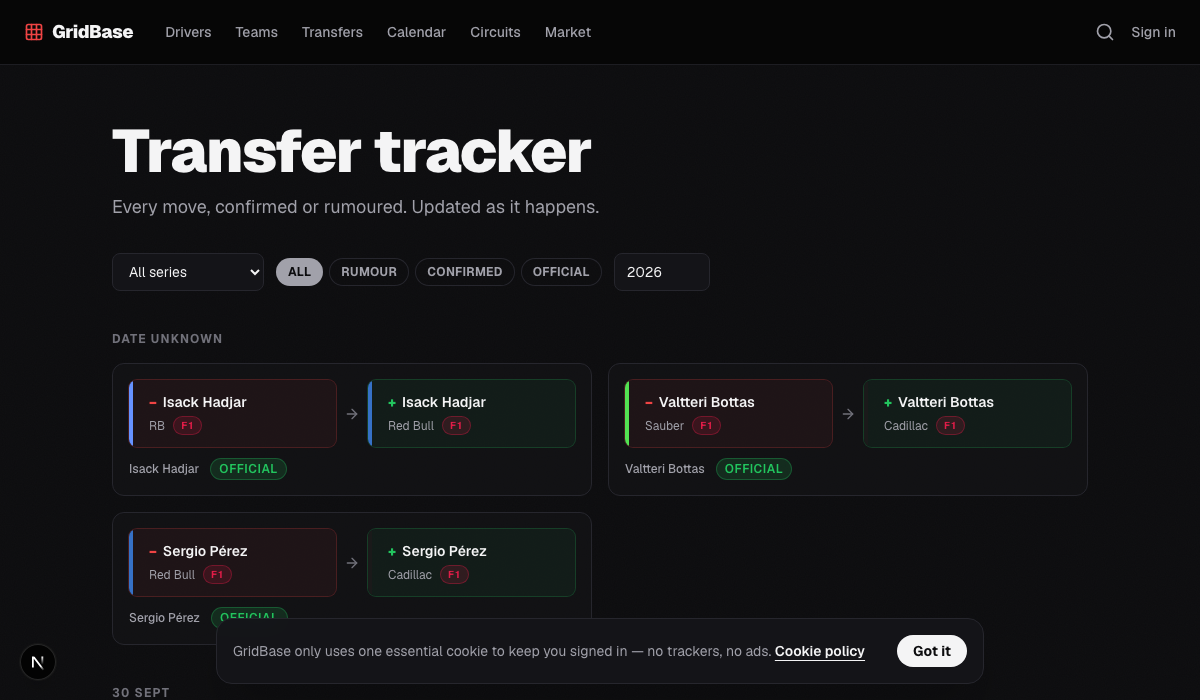
- GridBase logs every move with a status (rumour, confirmed, official) because the journey between those states is the story.
Every summer, Formula 1’s championship battle gets upstaged by a second competition that happens entirely in offices, motorhomes and encrypted group chats: the driver market. Seats open, rumours ignite, managers leak, teams deny, and somewhere between a paddock whisper and a press release, careers change forever. The sport calls it silly season, and despite the name, it follows rules as strict as any technical regulation.
This guide explains how F1 driver transfers actually work: the contract mechanics underneath the headlines, why the market moves in dominoes, how a rumour becomes an official announcement, and how to tell a real story from an agent planting noise. It’s also the logic behind how GridBase tracks transfers, every move in our database carries a status, from rumour to official, because the journey between those two states is where the drama lives.
What “silly season” actually means
Silly season is the period, traditionally mid-summer, though it now never fully stops, when speculation about driver moves dominates F1 coverage. The name is borrowed from an old newspaper term for the slow news months when outlandish stories filled pages. In F1 it stuck because, every year, some of the most outlandish stories turn out to be true.
Three structural facts make silly season inevitable:
- There are only 22 seats. F1 has the smallest labour market of any global sport. When the supply of seats is that scarce, every single opening triggers competition among dozens of qualified drivers.
- Contracts expire in waves. Teams tend to sign multi-year deals that end in the same seasons, so several seats often open simultaneously, and one big move can unlock all of them.
- Information is currency. A driver’s negotiating leverage depends on the alternatives he can credibly threaten. Leaking interest from a rival team is a negotiation tactic as old as the sport.
The result is a market that behaves less like sports free agency and more like a chess opening: nobody wants to move first, everybody positions against everybody else’s expected move, and when the first piece finally goes, the rest follow in a rush the paddock calls the domino effect.
The anatomy of an F1 driver contract
Public reporting reduces contracts to “signed until 2028”. The reality is a stack of interlocking clauses, and understanding them is understanding the market.
Duration and options
Most F1 contracts are two or three seasons, but the stated end date is only the start of the story. Contracts routinely include option years: an extra season that one party, almost always the team, can activate unilaterally by a deadline. A “contracted until 2027” driver whose team holds an option for 2028 is in a fundamentally different position from one whose deal simply ends.
Options cut both ways in negotiation. A team option gives the team flexibility but tells the driver he’s not fully wanted; a driver option (rarer, reserved for stars) lets a champion keep his exit open. Verstappen-tier drivers negotiate arrangements most of the grid can only dream about.
Performance clauses
The most market-moving clauses are performance escape hatches: if the team fails to meet a defined standard, a championship position by a certain date, for example, the driver may exit early. The reverse exists too: teams can include clauses releasing them if a driver underperforms a teammate by a defined margin or fails to score over a defined run.
These clauses are why mid-season announcements sometimes appear from nowhere. The public sees a driver “under contract”; the insiders know a clause window opened on July 31st.
Buyouts and release agreements
When a move can’t wait for a contract to expire, money solves it. Buyouts, where the destination team, the driver, or his sponsors compensate the current team for early release, are standard practice. The sums are rarely public but routinely reach eight figures for front-line talent.
A related mechanism is the mutual termination, dressed in press-release language about “exploring new challenges”. When both sides want out, the team to sign someone better, the driver to escape a sinking project, lawyers can dissolve a contract in days.
Gardening leave and the knowledge problem
F1 contracts guard secrets, not just services. A driver moving between rival teams carries setup philosophies, development directions and operational details in his head. Contracts manage this with restrictions on when a driver can begin work with his new team , he might be announced in August but forbidden from entering the new factory until January.
This is also why testing appearances matter in transfer detective work: the first day a driver is photographed at a new team’s facility tells you exactly when his old obligations ended.
Who actually does the deal
The driver’s manager
Almost every driver employs professional management, sometimes a famous ex-driver, sometimes a specialist agency, occasionally a parent. The manager’s job runs from negotiating retainers and bonuses to the darker art of market-making: ensuring rival teams know their client might be available, at exactly the moment it maximises leverage.
When you read “sources suggest Driver X is unsettled”, you are, more often than not, reading a manager at work.
The team principal and the driver programme
On the other side sits the team, but “the team” is rarely one voice. The team principal wants the fastest driver; the commercial department wants the sponsor a driver brings; the engine partner may have its own protégé to place. Works teams add manufacturer politics: a factory-backed driver can arrive as part of an engine deal, effectively bundled with the hardware.
Then there are the junior academies. Red Bull, Ferrari and Mercedes run development programmes whose graduates come with strings attached: contracts that give the parent team first claim on their services, often for years. When an academy driver excels in F2 or F3, his path to F1 runs through his patron’s decisions, not an open market.
The driver himself
The best drivers increasingly run their own careers with small trusted circles. The sport’s biggest recent moves have been driven by the drivers personally, direct conversations between a champion and a team boss, sealed long before managers papered the details. At the very top, the market is a network of personal relationships.
The domino effect: why one move triggers five
F1 transfer news arrives in cascades, and the mechanism is simple: every seat filled is a seat denied to everyone else who wanted it.
A typical cascade runs like this. A top team’s star leaves, that’s Domino One, and it’s the only truly free decision in the chain. The top team now raids the best available driver from a midfield team (Domino Two). The midfield team, suddenly short, promotes a junior or poaches from a rival (Domino Three). The rival backfills with a veteran who lost his seat somewhere else entirely (Domino Four). Finally, the veteran’s old seat goes to a rookie with sponsor backing (Domino Five).
One decision; five teams affected; ten drivers’ careers rerouted. This is why paddock insiders obsess over the first domino each season. Identify which top seat genuinely opens, and you can sketch the entire market six months before the announcements.
The Hamilton-to-Ferrari move that reshaped the mid-2020s was the perfect specimen: one champion’s decision at Maranello rippled through Mercedes (who promoted a teenager), the midfield (which reorganised around the displaced), and even other championships, as the squeezed-out looked to WEC and IMSA for their next chapter.
From rumour to official: the lifecycle of a transfer
At GridBase we log every transfer with an explicit status, because the state of a story is the story. Here’s what each stage really means.
Stage 1. Rumour
Somebody with an interest starts the fire: a manager building leverage, a team softening up fans for change, a journalist with one genuine source. Rumours are directionally useful, where there’s smoke, someone is at least holding matches, but individually unreliable.
How to weight a rumour: who benefits from it existing? A story that helps a driver’s contract talks deserves suspicion. A story that hurts everyone involved yet persists deserves attention, nobody plants damaging news about themselves.
Stage 2. Confirmed (but not announced)
Between rumour and press release lives the strange phase where a deal is done and everyone in the paddock knows it, but nobody may say so. Announcements wait for reasons that have nothing to do with the deal: sponsor alignment, a home race for maximum publicity, contractual courtesy to the outgoing driver, or simple choreography with other teams’ announcements.
Tell-tale signs of this phase: rivals’ broadcasters discussing the move in the past tense, the incumbent driver’s suddenly diplomatic answers, and sponsor social accounts following new drivers a touch too early.
Stage 3. Official
The press release, the awkward photoshoot with a cap, the quote about “a new chapter”. By the time a transfer is official, the market has usually priced it in, which is literally true on GridBase, where our fantasy market reacts to confirmed and official transfers with immediate price movements. A confirmed move to a top team lifts a driver’s price; a slide down the grid cuts it; a retirement floors it. (The mechanics are detailed in how fantasy driver pricing works .)
Reading the market like an insider
- Watch behaviour, not words. Teams deny until the moment they announce; that’s professional courtesy, not information. But a team testing a driver, or a driver skipping a sponsor event, is behaviour, and behaviour leaks truth.
- Track contract years, not headlines. Most of the market is predictable years out, just by mapping which deals expire together. GridBase’s transfers page shows the season each move takes effect precisely for this reason.
- Follow the engines. Engine partnerships move drivers. A works deal often carries driver placement obligations, and a customer team switching suppliers may inherit or shed talent accordingly.
- Respect the academies. Junior programme graduates don’t enter an open market. If a seat “belongs” to an academy pipeline, outsiders rarely win it, whatever the rumours say.
- Mind the money. Some seats are bought. Pay-driver economics are less crude than the term implies, sponsorship is revenue like any other, but when a struggling team faces a choice between talent and budget, budget usually wins.
Why transfers matter more than race results (sometimes)
A championship decides one year. A transfer decides an era. The moves that define F1 history. Senna to McLaren, Schumacher to Ferrari, Hamilton to Mercedes, Verstappen’s teenage promotion, did more to shape the sport’s next decade than any single season’s results.
Transfers are also the sport’s best predictive signal. Drivers and their managers see performance data fans never will: engine roadmaps, wind tunnel results, budget realities. When a smart driver walks away from a competitive seat toward an apparently weaker one, he usually knows something. Three of the last four regulation resets were “called” in advance by driver movements toward the teams that then dominated.
That’s the deeper reason we built transfer tracking into GridBase with statuses, seasons and full history per driver and per team: the market is the sport’s subconscious. Learn to read it, and F1 stops surprising you.
A season in the life of the driver market
- January–March: Quiet consolidation. Options exercised over the winter become public; testing form starts whispering about who might want to move.
- April–June: Positioning. Managers lunch with rival teams “socially”. The first genuine rumours with substance appear around the European rounds, where every decision-maker is in one paddock.
- July–August: Peak silly season. The summer break is deal season, no races, all meetings. Historically, the biggest bombshells drop immediately before or after the August shutdown.
- September–October: The cascade. First domino falls if it hasn’t already; the midfield resolves in weeks. Teams want line-ups settled before winter development commits resources.
- November–December: Cleanup. Final seats, usually rookie or pay-driver decisions, settle at the season’s end, sometimes literally in the last week.
Case studies: three transfers that explain the whole market
The earthquake: a champion moves on his own terms
When a multiple world champion decides to change teams, none of the normal rules apply. There is no negotiation over salary that matters, no academy claim, no performance clause to trigger, there is only the decision. Hamilton’s move to Ferrari was agreed at the very top, between driver and chairman, before most of either organisation knew it was being discussed. The public timeline made it look sudden; the private timeline ran for years, through informal conversations at dinners and vetoed earlier windows.
What an earthquake move teaches you: watch the relationships, not the contracts. Champions don’t respond to market conditions; they create them. The only early warnings are soft signals, a friendship between a driver and a rival executive, a pointed compliment in a press conference, a contract renewal that’s one year shorter than expected. That last one is the tell that repays the most attention: short renewals are bridges, and bridges lead somewhere.
The domino master: the midfield veteran who always lands
Every silly season has a driver who begins it seatless on paper and ends it employed somewhere better than expected. The mechanism is option management. A veteran with a strong reputation, a Hülkenberg, historically, becomes the market’s universal fallback: every team negotiating with its first-choice driver needs a credible plan B, and being everyone’s plan B means you only need one deal to collapse anywhere in the chain.
The skill is timing patience. Sign too early with a bad team and you’re locked out when a good seat opens; wait too long and the music stops. Managers of these drivers run what amounts to a probability tree of every other negotiation in the paddock. When you see a veteran “linked” with five teams simultaneously, that’s not indecision, that’s a portfolio.
The academy squeeze: when the pipeline is the market
The third archetype involves no free choice at all. A junior programme invests millions in a teenager, controls his contracts through every rung of the F2/F3 ladder, and then faces the moment of truth: a seat must be found, or the asset walks under the terms most academy contracts include. This deadline pressure produces some of the market’s strangest outcomes, juniors placed at rival customer teams, loans with buy-back clauses, and occasionally a promising career parked for a year in a reserve role that everyone involved knows is a gilded waiting room.
The squeeze explains transfers that look irrational from outside. A team dropping a solid veteran for an unproven teenager isn’t misreading performance; it’s servicing a pipeline whose economics only work if graduates graduate.
The money: what transfers actually cost
Driver transfers involve three distinct financial flows, and confusing them muddles every fan debate about “pay drivers” and salaries.
Salaries run from roughly a million dollars for a rookie on a junior-programme contract to figures north of fifty million for the sport’s icons, before bonuses for points, podiums and championships. Notably, driver salaries sit outside the cost cap, which is precisely why star drivers became even more valuable after the cap was introduced: they’re one of the few places unlimited money still buys lap time.
Transfer compensation, the buyout, flows between teams (or from sponsors to teams) when a contracted driver moves early. The sums are secret but occasionally surface in legal disputes and financial filings; eight figures for a front-line driver is the working assumption. Unlike football, F1 has no transfer-fee culture for out-of-contract drivers: run your contract down and you move free.
Sponsorship dowries travel with certain drivers, personal backers, national oil companies, family businesses, and can exceed the driver’s salary several times over. This is the economics behind the “pay driver” label, and it’s less cynical than it sounds: for a team fighting for survival, a driver bringing thirty million in backing while being eight tenths slower may genuinely be the rational hire. The grid has always worked this way; even some future world champions arrived with backing that opened their first door.
Transfers beyond F1: one market, many exits
A dimension casual fans miss: the F1 driver market doesn’t end at F1. It’s the apex of a connected global market, and the connections run both ways.
When a driver loses his F1 seat, his manager’s phone starts ringing from WEC Hypercar programmes, Formula E teams and IMSA squads, often within hours. A works Hypercar seat at Porsche or Ferrari is a genuinely elite job: factory salary, Le Mans glory, a decade of career runway. The endurance paddock is full of drivers whom F1 discarded and who then built careers arguably more decorated than the ones they lost. Track any ex-F1 name in the GridBase database and you’ll see the pattern: the year after the F1 exit, two or three series appear on their record as they test the market.
The flow reverses too. Endurance and Formula E success has become a shop window for F1 reserve roles and even race returns. And mid-career moves sideways, an F1 reserve racing WEC at weekends, a Formula E champion doing Le Mans, have become normal enough that GridBase tracks multi-series careers as a first-class concept (the multi-series badge you’ll see on many driver profiles).
This cross-series liquidity changes negotiation dynamics inside F1 itself. A driver with a credible Hypercar offer has a floor under his market value; a team knows its unwanted driver won’t hang around as a cheap reserve if Toyota calls. The best managers cultivate options across paddocks precisely to strengthen their F1 hand.
The information war: how transfer news actually breaks
The modern transfer story passes through a recognisable ecosystem, and knowing the food chain helps you time your trust.
At the source sit perhaps two dozen people who actually know, the driver, his manager, a handful of executives on each side. Around them, the first ring: senior journalists with decades of relationship capital, who typically know weeks before publishing and negotiate what they can print against future access. Then the specialist press, who verify with second-hand sources; then aggregators; then social media, where the story arrives simultaneously true, false, and exaggerated.
Practical trust heuristics, earned the hard way by every long-time fan:
- Track record beats logo. Specific journalists have decades-long records on transfer scoops; the outlet matters less than the byline.
- Specificity is a signal. “Contract signed Tuesday, announcement planned for the home race” is either true or career-ending for its author. Vague “links” cost nothing and mean nothing.
- Watch the denials’ grammar. “He has a contract for next season” is not “he will drive for us next season”. Teams almost never lie flatly; they answer questions nobody asked.
- Simultaneous smoke matters. One outlet floating a move is noise; three rivals with different sourcing converging within a day usually means the inner circle has started briefing.
On GridBase, this ecosystem maps directly onto our transfer statuses: a story enters as rumour when credible outlets converge, upgrades to confirmed when the deal is done-but-unannounced, and becomes official with the press release. The fantasy market deliberately reacts only to the last two, rumours are free; being right isn’t.
A worked example: reading one week of transfer news
To make the toolkit concrete, walk through a fictional-but-typical news week with the insider lens on.
Monday. A mid-tier outlet reports Driver A “in talks” with Team X. Ask the first question: who benefits? Driver A’s contract talks with his current team have reportedly stalled, so this smells like leverage, planted by his management. File as noise, probability unchanged.
Wednesday. Two senior journalists, different outlets, different sourcing traditions, both with strong scoop records, publish within three hours of each other that Team X has tested Driver A in a private simulator session. This is behaviour, not words; simulator invitations cost teams real time and secrecy. Upgrade materially. On GridBase this is the moment a story would enter the database as a rumour, converging credible sources.
Thursday. Team X’s principal, asked directly, replies: “Driver B has a contract with us for next season.” Parse the grammar, that sentence is true even if Driver B is being replaced within that contract, or paid off out of it. Note what wasn’t said: “Driver B will race for us.” A non-denial denial; probability up again.
Friday. Driver B posts a philosophical Instagram caption about “enjoying the journey”. His sponsor’s account quietly follows Driver A. The soft-signal layer is now fully lit. Meanwhile a third journalist reports a specific detail: announcement targeted for the team’s home race, five weeks out. Specificity is skin in the game, a falsifiable claim with a date. This is where a story typically flips to confirmed in our database, and where the fantasy market prices the move.
Five weeks later. Press release, cap photoshoot, “new chapter”. The market moved weeks ago; the announcement is theatre. Official.
That’s the entire skill, compressed: weight who benefits, privilege behaviour over statements, parse denials literally, and treat specific falsifiable details as the strongest currency in the ecosystem. Run this loop on the live transfers feed for one silly season and you’ll never read paddock news the same way again.
Follow the market as it moves: live transfer tracker, every 2026 driver, and the fantasy market where confirmed moves reprice drivers within minutes.
Check what you just learned. No stakes, no timer.
Sources
FAQ
What is F1 silly season?
Silly season is the period, peaking in mid-summer, when speculation about Formula 1 driver transfers dominates coverage. It exists because F1 has only 22 seats, contracts expire in overlapping waves, and leaking transfer interest is a standard negotiating tactic.
Can an F1 driver break his contract?
Effectively yes, through mechanisms built into the contracts themselves: performance clauses that create exit windows, buyouts where compensation is paid for early release, and mutual terminations when both sides prefer to separate. Very few F1 contracts run their full stated term when one party truly wants out.
Why do F1 teams deny transfers that turn out to be true?
Because announcements are choreographed events timed for sponsors, home races and contractual courtesy, while deals are agreed weeks or months earlier. A denial usually means “not announced yet”, not “not true”. This is why GridBase tracks transfers through rumour, confirmed and official statuses.
What is gardening leave in F1?
Restrictions preventing a driver (or engineer) who has signed for a rival from starting work there immediately, protecting the old team’s technical secrets. A driver can be announced in summer but barred from his new factory until his old contract formally ends.
Where can I follow every F1 transfer in real time?
The GridBase transfers page logs every move across F1 and other championships with driver, origin, destination, status and effective season, from first credible rumour to official announcement.