F2 and F3 Explained: The Road to Formula 1
How F2 and F3 work: spec cars, reversed grids, super licence points, academy politics and the brutal statistics of who actually reaches Formula 1.
- FIA F3 and F2 are the official spec-car steps below F1, sharing grand prix weekends so juniors race in front of the people who hire.
- Identical cars mean the timing screen measures drivers, not budgets: that is the ladder’s entire point.
- Reaching F1 requires 40 super licence points, earned mainly by finishing high in ladder championships.
- Roughly one F2 champion per year meets roughly one to three open F1 seats: most excellent juniors never graduate.
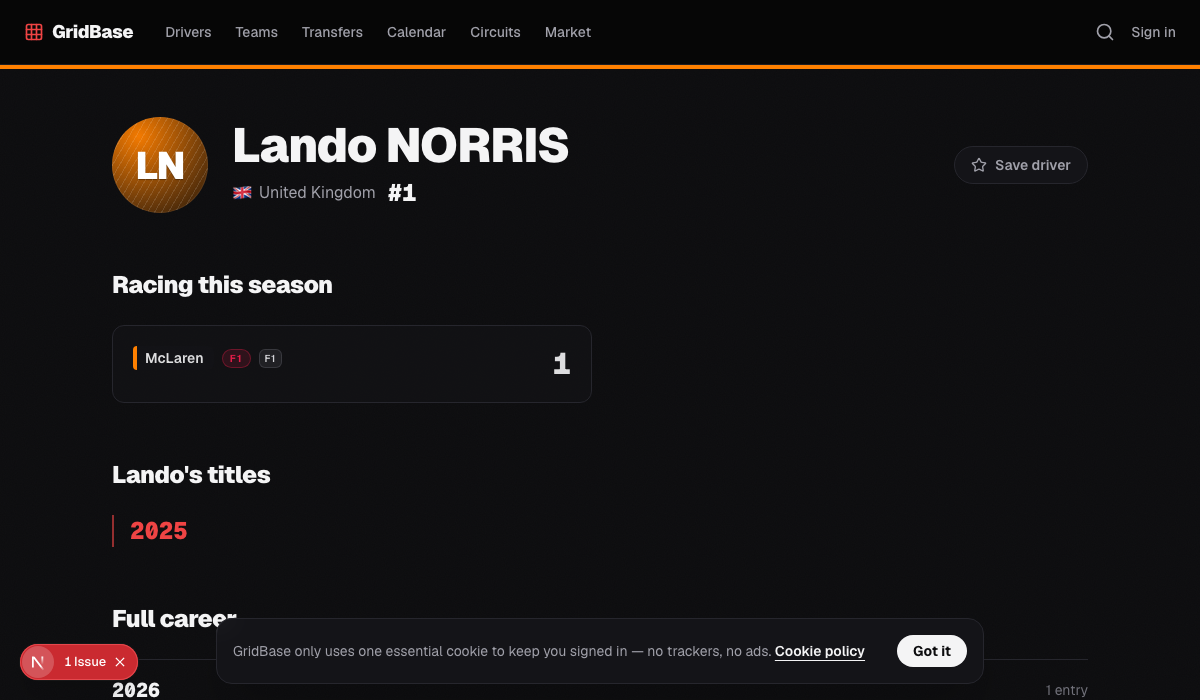
- The 2026 F1 rookies (Lindblad, Bortoleto’s generation) all came through this exact pipeline, visible in their GridBase career pages.
Every driver on the Formula 1 grid was, a few years earlier, a teenager in an identical car trying to beat thirty other teenagers in identical cars while the people who decide F1 careers watched from the paddock above. That proving ground is the FIA Formula 3 and Formula 2 ladder: the official staircase to Formula 1, and one of the most efficiently cruel talent filters in world sport.
This guide explains how the ladder actually works: the spec-car philosophy, the weekend formats built to showcase racecraft, the super licence arithmetic, the academy politics that decide who gets funded, and the statistics nobody tells the karting parents. The receipts are in the GridBase career pages, where every current F1 rookie’s climb is logged season by season.
The ladder at a glance
| Rung | What it is | Typical age |
|---|---|---|
| Karting | Where everyone starts; champions are scouted at 12 to 14 | 6 to 15 |
| F4 / regional F3 | First cars: national F4, then FRECA and equivalents | 15 to 17 |
| FIA F3 | Spec series on grand prix weekends, ~30 cars | 16 to 19 |
| FIA F2 | The final step: faster spec cars, same paddock as F1 | 18 to 22 |
| Formula 1 | 22 seats. That is the whole problem. | 18+ |
Why spec cars: the measurement argument
F2 and F3 exist to answer one question with minimum noise: who is the best driver? Identical Dallara chassis, identical engines, controlled tyres and limited setup freedom strip away the variable that dominates F1 itself, machinery. When the cars are the same, the timing screen becomes something close to a pure talent readout, corrected only for team operational quality (which varies, and matters, but by tenths rather than seconds).
This is the ladder’s genius and its honesty: an F1 scout watching an F2 race knows that the kid pulling three tenths on his teammate is actually three tenths better, a sentence that can never be said about F1 itself. It is also why ladder statistics, wins, poles, rookie-season championship position, carry so much predictive weight in every paddock conversation about the future.
Formula 3: thirty teenagers, one reputation each
FIA F3 is the ladder’s mass-selection stage: grids around thirty cars, drivers mostly 16 to 19, racing on grand prix weekends across Europe and beyond. The racing is notoriously chaotic, enormous slipstream packs, restarts like cavalry charges, and that chaos is partly the curriculum: survival, positioning and wheel-to-wheel judgement under pressure are exactly what the next rung demands.
What scouts actually watch in F3 is trajectory, not just titles: qualifying pace against experienced teammates, error rates in the pack, and improvement curve across a season. A rookie who finishes fifth with three poles can out-rank the champion in the market’s eyes; the ladder’s evaluators are more sophisticated than its trophies.
Formula 2: the shop window
F2 is where careers resolve. The cars are properly fast (little over F1 lap-time deltas of 10 to 15 seconds), the tyres degrade by design to teach management, and the paddock is literally F1’s: same weekends, same media, team principals watching from their own hospitality. Every F2 session is a live job interview.
The championship’s structural cruelty: champions must leave (title winners cannot return), and roughly one champion per year meets one to three genuinely open F1 seats. The surplus of the qualified is the defining fact of the whole system, and the reason the academy politics below decide as much as lap times.
The weekend format: reversed grids and racecraft exams
Both series run multi-race weekends built to test different skills: qualifying sets a feature-race grid (the "real" race, with pit stops in F2), while a sprint race gridded by reversing the top qualifiers forces the fastest drivers to overtake through the pack. The reversed grid draws purist complaints every single season, and stays every single season, because it manufactures exactly the evidence F1 hiring committees want: can this driver pass, defend, and manage risk from the wrong end of the field?
Read results accordingly: sprint wins from P8 are racecraft exhibits; feature wins from pole are speed exhibits; a champion needs a portfolio of both.
The sprint format also produces the ladder’s most valuable statistical artefact: overtake counts under pressure. Junior analytics teams (yes, they exist) chart every pass a prospect makes by corner type and risk profile, and those charts travel: an F1 team evaluating two similar CVs will read pack behaviour like scouts read game film. The reversed grid, whatever the purists say, generates exactly the data that separates the brave from the merely quick.
Super licence points: the eligibility algebra
Reaching F1 is not just being wanted; it is being eligible. The FIA requires 40 super licence points, accumulated over rolling recent seasons, awarded by finishing position across dozens of championships. The scale is steeply tilted toward the official ladder: the F2 title alone is worth the full 40; high F3 finishes pay substantial points; success in other routes (national series, endurance, IndyCar) pays too, at rates the FIA tunes periodically.
The system’s purpose is gatekeeping seriousness, no more pay-to-play teenagers with thin CVs, and its side effect is strategic: academies plan their juniors’ seasons partly as points-harvesting itineraries, and an otherwise attractive F1 signing can be legally impossible for lack of paperwork points. It is bureaucracy, and it is also the reason the modern grid’s floor of competence is the highest in the sport’s history.
Academy politics: who pays, decides
Behind almost every ladder career stands a patron: Red Bull’s junior programme, the Ferrari and Mercedes academies, Alpine’s and McLaren’s schemes. Academies pay the bills (see the costs below), supply simulator work and coaching, and in exchange control the asset: contracts giving the parent team first claim for years.
The politics shape everything. An academy junior races not only against the field but against his stablemates, because the programme has one F1 seat to give and three prospects. Placement decisions blend performance with timing (whose contract year aligns with whose retirement), and the endgame is visible every season in the transfer feed: juniors parked in reserve roles, loaned to customer teams, or released a year before blooming somewhere else. The ladder measures talent cleanly; the exit from the ladder is measured in leverage.
What it costs (the part nobody frames)
Order-of-magnitude numbers, openly discussed in every paddock: karting at national level costs tens of thousands a year; F4 a few hundred thousand; FIA F3 around a million euros a season; F2 twice that and beyond. A family funding a child from karting to an F2 title unaided is spending several million euros on a lottery ticket whose grand prize is a job interview.
This is the ladder’s uncomfortable truth and the academies’ entire leverage: for all the spec-car meritocracy on track, access to the track is rationed by capital. The system’s partial correction is that genuine outlier talent gets funded, scouts exist precisely to find the karting prodigy before the money runs out, but "partial" is the honest adjective, and every fan should hold both facts at once.
One more political layer completes the academy picture: the customer-team placement. Academies with more prospects than seats lease juniors to unaffiliated midfield teams, sweetened with engine-deal discounts or simulator support. The junior gets mileage, the customer team gets subsidised talent, the academy keeps its option, and the arrangement’s tensions (whose engineers see whose data, who decides strategy when the loaner races the parent’s junior) fill silly-season columns every year. When a rookie’s seat announcement names a team with no academy affiliation, look for the engine badge: the affiliation is usually there, one contractual layer down.
The brutal statistics
Compress the funnel into numbers and the shape is unmistakable:
- Tens of thousands of competitive kart racers worldwide feed the base.
- A few hundred hold FIA F3/F2 ladder seats at any moment.
- Roughly one F2 champion and two or three credible graduates emerge per year.
- F1 opens one to three rookie seats in a typical season, and 2026’s expanded grid was a historically generous year.
The conversion rate from "excellent junior" to "F1 race driver" is a few percent. Which reframes the ladder’s real function: it is not a conveyor to F1; it is a certification of elite ability that most holders will cash somewhere else, and the somewhere-else options (below) are better than they have ever been.
The 2026 graduates: the pipeline, proven
The current F1 grid is the ladder’s live advertisement. Its youngest members, Racing Bulls’ Arvid Lindblad and Audi’s Gabriel Bortoleto among them, climbed exactly this staircase, with Bortoleto’s back-to-back junior titles the textbook case of a trajectory the market could not ignore. Their career pages read like this article in database form: karting, F4, the ladder rungs, then the transfer entry that moved them onto the grid. Follow this season’s F2 leaders the same way, and you are watching the 2028 grid form in real time.
How the ladder was built: from GP2 to the FIA pyramid
Today’s tidy staircase is recent. For most of F1’s history the feeder scene was a chaotic archipelago: European F2 and F3000 in various guises, national F3 championships whose relative strength changed yearly, and rich uncles’ championships of varying credibility. Talent still surfaced, but comparing a British F3 champion against a Japanese F3000 graduate was genuinely hard, and F1 teams each ran private scouting mythologies.
The consolidation came in waves: GP2 (2005) unified the final step with spec cars and grand prix weekends, and its rebrand as FIA Formula 2 in 2017, alongside the creation of today’s FIA Formula 3 from merging GP3 and European F3, completed the official pyramid. The super licence points system arrived in the same era, explicitly channelling careers through the sanctioned rungs. The design intent was transparency: one ladder, one measuring stick, every prospect’s record legible to every team principal. Two decades of champions later, the verdict is that it worked, with the honest side effect every centralised system produces: the official path became nearly mandatory, and its costs became the sport’s gatekeeper.
The teams that make champions
Spec cars do not mean equal teams, and the ladder’s open secret is that where you sign matters almost as much as how you drive. A handful of junior powerhouses, the Premas and ARTs of the paddock, in each era, account for a wildly disproportionate share of titles. Their edge is not machinery (identical by rule) but everything wrapped around it: engineer quality and continuity, data libraries accumulated across hundreds of race weekends, simulator programmes, and the recruiting flywheel where academies place their best prospects with the best teams, which keeps those teams best.
For evaluators this creates the ladder’s classic correction factor: a P4 season in a mid-grid junior team can outrank a title won in the dominant one, and scouts price it accordingly. For families and managers it creates the second budget line nobody warns about: the top teams’ seats cost the most, precisely because they convert money to results most reliably. When you read a junior’s career page, read the team column as carefully as the position column; the paddock does.
The other ladders: America and Japan
The FIA pyramid is the biggest staircase, not the only one, and two alternatives matter to any career map. The American Road to Indy runs USF Juniors through Indy NXT into IndyCar, cheaper per rung than the European ladder, with prize-money scholarships that genuinely fund promotion, and IndyCar itself pays super licence points that have put its champions inside F1 eligibility. The Japanese route, Super Formula and Super GT, offers factory-supported professionalism and has served as both a proving ground for F1-bound talent and a destination career in its own right; engine-partner politics have repeatedly routed European prospects through a Japanese season on their way to grand prix seats.
The strategic reading for a modern career: the ladders interconnect. A stalled European junior can convert to Indy NXT economics; a Super Formula season can rehabilitate a reputation the F2 paddock wrote off. The series index tracks these championships side by side, and the drivers who treat the world’s ladders as one market, rather than worshipping a single staircase, are the ones whose careers survive their first setback.
Inside a junior season: what the money buys
The million-euro F3 season deserves an itemisation, because the number sounds abstract until you see the operation it funds. A junior team’s per-driver season covers the car lease and spares pool (crash damage is billed separately, a fact that shapes driving styles), a race engineer and data engineer’s season, test days at premium circuit rates, freight to a dozen international rounds, simulator preparation before each, and the coaching layer: a driver coach at every session, video and data review between them.
The driver’s own calendar is the part outsiders underestimate. Racing weekends are a minority of the job: between rounds live factory simulator days, fitness blocks, sponsor content obligations, kart sessions for sharpness, and the endless travel economy-class that the budget’s optics require. A serious junior season is a 60-hour-a-week profession performed by teenagers, which is precisely the point: the ladder is stress-testing the professional habits, not just the driving (the training regime is detailed in our careers guide). Scouts ask team engineers about a prospect’s debrief quality as often as his lap times, and the engineers keep receipts.
Watching the ladder well: a fan’s guide
F2 and F3 are also simply excellent television, and free education for the F1-curious. Practical viewing notes: races run on grand prix Saturdays and Sundays before the main events, so one weekend pass covers three championships. Watch the feature race starts: standing starts with cold-ish tyres and rookies produce first corners F1 has not dared since the nineties. Watch tyre cliffs: junior compounds degrade dramatically by design, so the last five laps routinely invert the order, exactly the management skill F1’s 2026 energy era will demand.
And keep a scouting notebook, because the ladder rewards it like no other series: pick three drivers each season, one champion-elect, one rookie, one contrarian pick the paddock has cooled on, and follow their career pages and market moves through the winter. Within two seasons your private notes will beat the broadcast narratives, and you will experience F1 rookie announcements the way insiders do: as confirmations, not surprises.
When F1 says no: the other exits
The modern sport’s best structural change is that the ladder’s surplus talent no longer evaporates. An F2 graduate without an F1 seat today walks into a genuinely elite market: Hypercar factory programmes recruit ladder speed aggressively (often via a fast Silver-rated season in LMP2), Formula E offers world-championship careers, IndyCar rewards exactly the racecraft the sprint races taught, and GT racingsupplies salaried decades. On GridBase you can trace dozens of careers that "failed" at the F1 gate and flourished within two seasons, multi-series badges and all. The staircase has more than one landing, and the view from most of them is excellent.
Trace the pipeline yourself: F2 drivers, F3 drivers, the moves that graduate them, and the fantasy market where tomorrow’s stars are still cheap.
Check what you just learned. No stakes, no timer.
Sources
- FIA Formula 2: official site
- FIA Formula 3: official site
- FIA: super licence regulations (International Sporting Code, Appendix L)
FAQ
What is the difference between F1, F2 and F3?
F1 is the open-development pinnacle where teams design their own cars. F2 and F3 are spec championships on the same race weekends: everyone runs identical Dallara chassis and engines, with F3 as the entry tier for drivers from karting or regional series and F2 as the final step before F1.
How long do drivers spend in F2 and F3?
The strong pattern is one to two seasons per rung. Champions who win quickly (especially rookie champions) carry the most F1 currency; a third season on the same rung usually signals a stalled trajectory to the paddock, fairly or not.
Does the F2 champion automatically get an F1 seat?
No. The title grants the 40 super licence points needed for eligibility, and champions cannot stay in F2 the following year, but a seat still depends on academy backing, open cockpits and budget. Several champions have gone straight to reserve roles or other categories instead.
How much does it cost to race in F2 or F3?
Order of magnitude: a competitive F3 season runs around a million euros and F2 twice that or more, funded by families, sponsors and academies. The spec formula controls costs compared with open development, but the ladder remains brutally expensive, which is why academy backing decides so many careers.
Where can I follow F2 and F3 drivers’ careers?
GridBase tracks junior careers season by season: every entry, title and the transfer that eventually moves a graduate onto the F1 grid, so you can trace exactly how each current F1 rookie climbed the ladder.