How to Become a Racing Driver: From Karting to a Professional Seat
The honest roadmap to a racing career: karting, single-seaters, GT routes, sim racing openings, costs at every step and the licences that get drivers paid.
- Almost every professional driver started in karting between ages 6 and 14; it remains the sport’s talent bedrock.
- Two main career routes exist: the single-seater ladder toward F1 (fast, brutal, expensive) and the GT/endurance route (wider, longer, salaried).
- Costs scale from thousands (club karting) to millions (F2); sponsorship-raising is a core professional skill, not an embarrassment.
- FIA driver ratings mean starting age matters: a first licence at 30+ makes you Bronze, which is its own valid pro-am path.
- Sim racing now produces real professional drivers, and remains the cheapest place on earth to build racecraft.
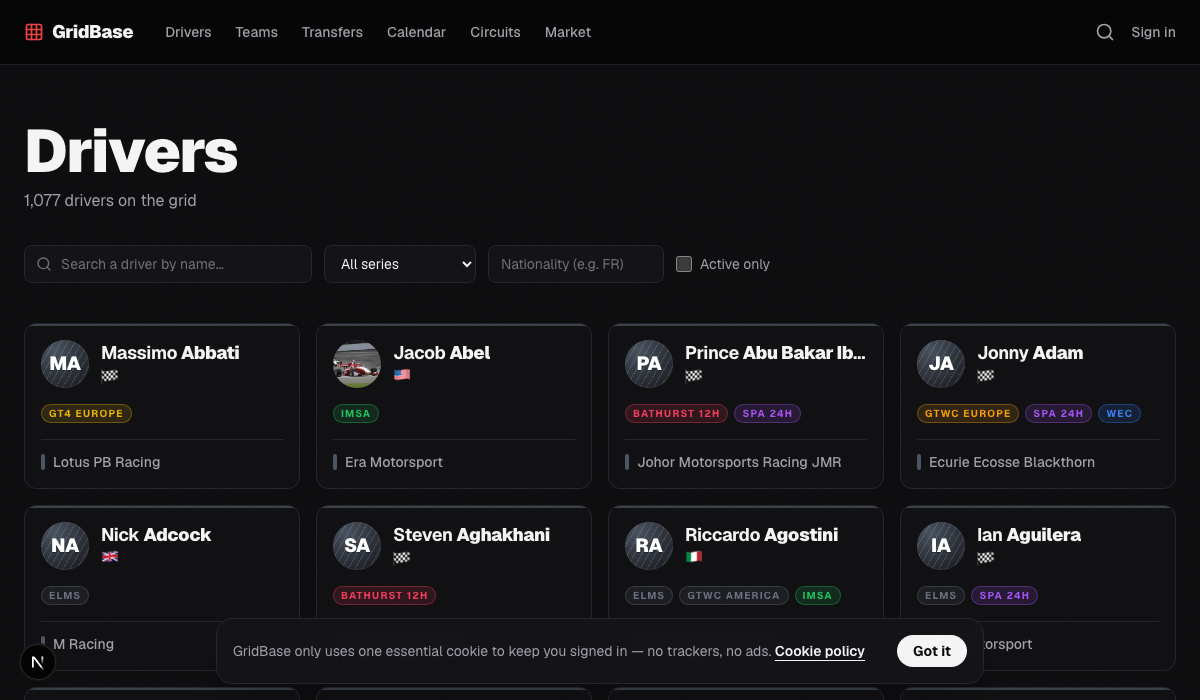
Every racing career starts with the same question asked in a thousand bedrooms: how do you actually become a racing driver? The internet’s usual answers are either fairy tales or gatekeeping. This guide is neither: a step-by-step map of the real routes, karting to the F1 ladder, the GT and endurance path, the sim racing door, with honest costs, the licence system, and what teams actually pay for. The careers in the GridBase database are the evidence base: a thousand professional paths, logged season by season.
The honest truth first
Three facts frame everything below. First, motorsport is the most capital-intensive sport on earth; talent is necessary and not sufficient, and pretending otherwise wastes families’ savings. Second, "racing driver" is not one job: Formula 1 has 22 seats, but the wider professional sport, GT racing, endurance prototypes, national championships, employs thousands, and most good careers live there. Third, the earlier you start, the more doors stay open, but doors exist at every age, they just have different names on them.
Step 1: karting, the non-negotiable foundation
Virtually every professional driver alive learned racecraft in a kart. Karting teaches the sport’s permanent skills, throttle precision, slipstream chess, defending without fouling, at 4,000 rpm and eye-level speed, for the lowest cost the sport offers. The pathway inside karting runs from club level (a few thousand a season, secondhand kart, family van) through national championships (tens of thousands, professional teams) to the international CIK-FIA classes where world championships are scouted by every academy in the sport.
The ages matter because the scouts’ calendars are fixed: F1-track prospects are identified at 12 to 14. But hold the number gently: karting is also where club racers race happily for decades, and where adult beginners should start too, for exactly the same reasons the eight-year-olds do.
Step 2: first race cars (15 to 17 on the fast track)
The classic first car is Formula 4: national championships, ~160 hp spec single-seaters, a season cost in the low-to-mid six figures, and the first rung where the super licence points ladder begins. Alternatives at the same rung: entry GT machinery (GT4), club touring cars, or national formula series, each cheaper than F4 and each a legitimate first chapter, depending on which route (next section) you are building toward.
The fork: single-seaters or GT
Around 16 to 18, money and ambition force the sport’s defining choice:
| Single-seater ladder | GT / endurance route | |
|---|---|---|
| Destination | F1 (or IndyCar, Formula E) | GT3, Hypercar, Le Mans |
| Seats at the top | Very few | Hundreds, salaried |
| Cost curve | Steep: millions by F2 | Gentler; earning starts sooner |
| Career length | Short window | Decades (ratings help veterans) |
| Failure mode | Out of money before F1 | Plateau at national level |
The smartest modern careers treat the fork as a sequence, not a choice: run the single-seater ladder as far as funding allows, then convert the speed into the GT world, where a young ex-formula driver’s Silver rating is prized. Half the current Hypercar grid took exactly that path; their career pages show it.
Route A: the F1 ladder, eyes open
The full anatomy of F3 and F2 has its own guide; the career-planning summary is: two seasons per rung maximum (the market punishes lingering), academy backing is the funding problem’s only reliable solution, and the statistics are brutal, a few percent of excellent juniors reach F1. Plan the exit before you need it: the drivers who treated the ladder as speed certification rather than F1-or-bust kept their careers, and often ended up better paid than the backmarkers who made it.
Route B: GT and endurance, the sport’s real jobs market
The GT3 world is where most professional careers actually live. The standard climb: GT4 (accessible machinery, pro-am grids) to national GT3 to international GT3, building results and an FIA rating along the way. From there the elite branch continues into prototypes: LMP2’s pro-am crews hire fast young drivers cheaply, and LMP2 is the Hypercar factories’ favourite scouting pool.
Two structural advantages define this route. Money flows the right way sooner: a quick professional is paid to partner the amateurs who fund pro-am racing, sometimes within two seasons of starting. And careers last: the rating system’s age adjustments keep excellent veterans employable into their fifties. It is the difference between a lottery and a profession.
Route C: sim racing, the door that finally opened
The sim route is real now, with honest caveats. Manufacturer esports programmes have converted champion sim racers into licensed, contracted professionals; several notable careers began entirely on a rig. The odds resemble the F1 ladder’s, elite sim fields are enormous, but the entry cost is three orders of magnitude lower, which changes who gets to try.
The larger truth: simulators are no longer an alternative route so much as part of every route. Professional teams run sim programmes; junior academies test prospects on rigs before karts; and for a developing driver, structured sim racing is the cheapest racecraft laboratory ever built. If you are reading this at any age with any budget: the rig is where you start tonight.
A note on what the sim cannot give you, for balance: physical adaptation (real g-forces and heat have no home version), consequence calibration (the risk circuits of a brain that knows crashes are free learn differently), and the political skills of a paddock, sponsor breakfasts, engineer relationships, the theatre of a driver briefing. The modern consensus among coaches: sims accelerate the first 80% of racecraft at 1% of the cost, and the last 20% still costs exactly what it always did. Budget accordingly.
Licences and ratings: the paperwork ladder
Racing’s credential system climbs alongside you. National club licences come first: typically a medical, a theory course and observed race weekends. Results unlock international FIA grades, culminating in the Super Licence F1 requires (40 points via championship results). In parallel, once you race internationally, the FIA categorisation tags you Bronze, Silver, Gold or Platinum, and that rating becomes your market identity in the pro-am world. Strategic note for late starters: a first licence at 30+ means Bronze, which is an asset: Bronze-rated seats exist in every pro-am class up to Le Mans itself.
The money, itemised honestly
- Club karting: low thousands per season.
- National karting: tens of thousands.
- F4: a few hundred thousand.
- FIA F3 / F2: one to several million per season.
- GT4 season: low six figures; GT3 pro-am seat: mid six figures, unless you are the paid pro.
- Sim racing: a competitive rig for the price of one kart engine rebuild.
Where does the money come from? Family, then sponsors, and sponsorship-raising is a core skill, not a shame: preparing decks, delivering value to backers, building a public profile. Every professional you admire spent years doing it. Budget one honest sentence: if the plan requires miracle funding at step four, redesign the plan at step one, usually toward the GT route, where the sport starts paying you back sooner.
The skills that actually get you paid
Speed opens the door; the rest of the package signs the contract. In rough order of how teams weight it:
- Consistency: the metronome beats the hero lap in every professional category, especially endurance.
- Technical feedback: engineers champion drivers who accelerate development; it is a hireable skill.
- Tyre and energy management: the modern formula skillset (see our strategy guide) applies from F4 to Hypercar.
- Racecraft in traffic: multi-class endurance and reversed-grid sprints exist precisely to test it.
- Fitness and heat tolerance: non-negotiable and fully within your control, the cheapest advantage available.
- Professionalism: sponsor handling, media, punctuality, coachability. Pro-am team owners hire the pro who makes their amateur faster and their partners happier.
The sponsorship section deserves one concrete artefact: what a working driver deck actually contains. Page one: who you are and the season’s programme (series, calendar, media reach of each event). Page two: the audience, social following with engagement rates, not vanity totals; email list; local press history. Page three: the inventory, car and suit placement photographed on real machinery, hospitality allocations, content days, speaking appearances. Page four: packages with prices and, crucially, last season’s sponsor outcomes (photos delivered, posts published, leads generated). Racing results appear once, as context. Sponsors are buying the machine that produces attention; the lap times are merely its exhaust note.
Starting as an adult
Skipped childhood karting? The sport still has room, with honest expectations. The path: racing school and club licence, club karting or entry saloon racing for craft, then the pro-am GT world, where your Bronze rating makes you the driver category the entire economy is built around. Adult-start Bronzes race, and win, at the Spa 24, Daytona and Le Mans. It costs money rather than childhood, the trade most of the paddock’s amateurs happily made, and the quality of their racing lives is not a consolation prize.
Training like a professional (before anyone pays you to)
The gap between fast amateurs and employable professionals is rarely raw speed; it is preparation infrastructure, and most of it costs discipline rather than money. The physical baseline: racing is an endurance sport wearing a helmet, sustained heart rates in the 160s, cockpit temperatures above 50°C, and neck loads that untrained drivers simply cannot hold for a stint. The training canon is unglamorous: cardio volume, neck and core work (the home-built neck harness is a junior-formula rite of passage), grip strength, and heat adaptation. Every proven driver you follow does this daily; every coach can name careers that stalled because a fast teenager treated fitness as optional.
The mental side has professionalised just as far. Data review is the core skill: modern club cars log everything, and the driver who spends an hour overlaying his braking traces against a faster teammate’s improves at double the rate of the one who just does more laps. Add structured simulator work (specific corners, specific weaknesses, not aimless hot-lapping), video review, and the discipline sports psychologists teach, routines that make qualifying nerves boring. None of this requires a budget; all of it shows up in the lap times that attract one.
The sponsorship craft: racing’s real second job
Since funding decides careers, treat raising it as a skill with its own curriculum. The core insight successful drivers learn early: sponsors buy value, not dreams. A deck that says "help me reach F1" competes with charity; a deck that says "here is the audience, hospitality access and content channel your brand rents by backing me" competes with marketing spend, and marketing budgets are thousands of times larger than philanthropy.
The practical toolkit: a professional one-page deck with real numbers (social reach, event footfall, media appearances), a content habit (drivers who document their season build the audience they then sell), deliberate networking in business communities rather than racing ones (the paddock has no money to give you; the local chamber of commerce might), and scrupulous delivery, sponsor reports after every round, logos photographed, promises kept. Small local deals compound into bigger ones because the reference chain is the product. The drivers who master this skill effectively remove the funding ceiling on their talent; the ones who consider it beneath them are usually the ones explaining, years later, that money ended their career. It did; they let it.
The other seats in the paddock
An honest career guide includes the exits that keep you in the sport. The skills a racing pursuit builds, technical literacy, data analysis, performance under pressure, sponsor craft, map directly onto the paddock’s other professions: race engineering and data engineering (the ladder’s engineers increasingly arrive via sim racing and junior-team internships), driver coaching (every pro-am grid employs dozens, many of them exactly the almost-made-it drivers this guide describes), team management, media, and the growing esports-coaching economy.
This is not consolation-prize talk: several of the most influential people in any paddock are former drivers whose careers plateaued at national level and who converted the knowledge into longer, arguably better careers than the ones they first wanted. The database’s team pages are full of them. If you love the sport enough to attempt the driving path, you already have the disease that makes the other seats satisfying, and knowing they exist makes the driving gamble rational instead of desperate.
Five myths, retired
- "Talent always finds a way." The sport’s most expensive lie. Talent plus funding plus management finds a way; unfunded talent finds sim racing and coaching careers. Plan for all three legs or plan to stop.
- "You must risk everything to prove commitment." Teams hire professionals, not martyrs. The drivers with education backstops and diversified skills negotiate better, race calmer and last longer; the all-in gamble mostly signals bad planning to exactly the people you want to impress.
- "GT racing is where failed drivers go." Tell that to the factory Hypercar aces earning seven figures at Le Mans. The single-seater ladder is a route, not a verdict, and the GT world employs more professionals than F1’s entire history combined.
- "Simulators create bad habits." A decade-old prejudice, dead in every professional paddock: factory teams run sim programmes, juniors are assessed on rigs, and the habit problem inverted, drivers now arrive with racecraft their budgets never bought on track.
- "Starting after childhood is pointless." Only if F1 was the sole point. The pro-am pyramid was built for exactly the opposite case, and Bronze-rated adults race at Le Mans every June, on merit, within the rules, having started in their thirties.
A note for parents at the karting gate
Since half this article’s readers are parents doing diligence, the distilled counsel. Set the budget ceiling before the first national season, in writing, for yourselves: the ladder’s escalation is designed to feel incremental, and families who decide limits in advance make better calls than families who decide mid-season with a championship at stake. Buy coaching before equipment: the tenth-hand kart with a great coach beats the factory kart without one, at every level below international.
Protect the exits: school genuinely matters, not as a backup platitude but because the sport’s own best jobs (engineering, management, the professional coaching economy) recruit from educated ex-racers. Watch for the real signals, not trophies: coaches’ honest assessments, how the child debriefs after bad days, whether the hunger is theirs or yours, every karting paddock has both kinds, and everyone except the parents can tell which is which. And enjoy it: whatever happens at the gate of the professional funnel, you are spending weekends watching your kid do something difficult and brave, which was the point before the spreadsheets arrived.
A realistic plan, whatever your age
- Tonight: structured sim racing; join organised leagues, learn data.
- This year: club karting licence and a season of real racecraft, at any age.
- Years 2 to 3: the fork, honestly assessed: funding and age pick your route more than desire does.
- Every season: convert results into the next rung’s funding; build the sponsor file; keep the exit routes warm.
- Always: study the careers that worked. The database holds a thousand of them, and the patterns repeat: consistency, conversion, and knowing which paddock wants what you have.
Study the evidence: real career paths on GridBase drivers, the moves that shaped them, and the championships hiring right now.
Check what you just learned. No stakes, no timer.
Sources
- FIA: Karting (CIK-FIA) official site
- FIA: Driver Categorisation Regulations
- FIA Formula 3: official site
FAQ
At what age do you need to start to become a racing driver?
For the F1-track route, karting by roughly age 8 to 12 is the norm and first cars by 15. For GT and endurance careers, later starts work: plenty of paid professionals began in their late teens, and the pro-am world welcomes competitive drivers who start even in their thirties or forties as Bronze-rated racers.
How much does it cost to become a racing driver?
Club karting costs a few thousand per season; national karting tens of thousands; F4 a few hundred thousand; FIA F3 around a million and F2 beyond it. The GT route is gentler: a funded GT4 season can cost a low six-figure sum, and from there results can attract salary-paying teams. Sponsorship raising is part of the job at every level.
Can you become a professional driver through sim racing?
Yes, genuinely, though rarely. Esports programmes run by manufacturers have converted top sim racers into licensed professionals with real racing contracts. More commonly, simulators are where every modern professional builds and maintains racecraft cheaply; treating the sim seriously is now simply part of the career.
Do you need a special licence to race?
Yes: national club licences come first (typically via a medical, a theory course and observed races), then international FIA grades as your results progress. F1 requires the top tier, the Super Licence, with 40 points earned through junior championship results.
What do teams actually look for besides speed?
Consistency, technical feedback, tyre management, racecraft under pressure, fitness, sponsor professionalism and the ability to sell yourself. At every level above karting, drivers are hired as complete packages, and the fastest lap is only one line of the package.