WEC Hypercar Explained: LMH vs LMDh and BoP
What is a Hypercar? How LMH and LMDh differ, why BoP keeps eleven manufacturers honest, who races in 2026 and how the WEC's top class works.
- Hypercar is WEC’s top class since 2021: purpose-built prototypes capped around 500 kW, fighting for overall victory at Le Mans.
- Two rulebooks share one grid: LMH (full in-house design, optional front hybrid) and LMDh (spec chassis and hybrid, also IMSA-eligible).
- Balance of Performance adjusts weight, power and stint energy per car so both platforms can race each other honestly.
- Eight-plus manufacturers race the class in 2026: Toyota, Ferrari, Porsche, Cadillac, BMW, Aston Martin, Peugeot and Alpine.
- Three drivers share each car, and crews are engineered to balance one-lap pace, night consistency and race-closing craft.
Ten years ago, sports car racing’s top class was dying: three manufacturers, unsustainable budgets, and grids so thin that a single withdrawal threatened the category. Today, the Hypercar class of the FIA World Endurance Championship (WEC) is the most manufacturer-crowded battlefield in world motorsport, Ferrari against Porsche against Toyota against Cadillac against BMW against Aston Martin against Peugeot against Alpine, all for overall victory at Le Mans.
This guide explains everything about the class: what a Hypercar actually is, the crucial difference between LMH and LMDh rules, how Balance of Performance works and why it’s controversial, who the 2026 contenders are, and how driver crews are built. Whether you arrived from Formula 1 curious about the other side of the fence, or you’re building a fantasy endurance roster and want to understand what you’re buying, this is the complete picture.
What is the Hypercar class?
Hypercar is the top category of the World Endurance Championship, the cars that fight for outright victory in every race, including the 24 Hours of Le Mans. The class was introduced in 2021 to replace LMP1, the previous prototype formula whose spiralling costs had driven away every manufacturer except Toyota.
The name is mildly misleading. Hypercars are not road-going hypercars with numbers on the doors; they are purpose-built racing prototypes (with an option, rarely used, to derive them from road cars). What the name signals is intent: a category with the aura of the world’s most extreme machines, at a cost that manufacturers can justify.
- Power: capped around 500 kW (about 670 hp), deliberately less than the old LMP1 monsters.
- Weight: just over a tonne, far heavier than an F1 car.
- Speed: around 340 km/h at Le Mans, lap times slower than LMP1’s peak by design.
- Endurance: built to run 24 hours flat out. An F1 car races for two hours; a Hypercar’s race distance at Le Mans exceeds an entire F1 season.
Slower than the peak of LMP1, and nobody cares, because the class solved the only problem that mattered: making top-level endurance racing affordable enough that manufacturers actually show up.
LMH vs LMDh: one class, two rulebooks
The masterstroke, and the main source of confusion, is that Hypercar merges two different technical platforms into one class. Understanding the split explains half of every paddock argument.
LMH: the thoroughbred route
Le Mans Hypercar (LMH) is the “pure” rulebook, governed by the FIA and ACO. Constructors design the entire car themselves: chassis, aerodynamics, hybrid system. LMH permits a front-axle hybrid motor, giving, in effect, four-wheel drive above a set deployment speed, and grants maximum design freedom within the performance windows.
LMH is the choice of manufacturers who want full technical identity: Toyota, Ferrari, Peugeot, Aston Martin (whose Valkyrie is the rare road-car-derived entry). It costs more; it belongs entirely to you.
LMDh: the shared-platform route
Le Mans Daytona h (LMDh) was co-created with IMSA, the North American series, to let one car race in both championships. An LMDh car starts from a standardised chassis supplied by one of four approved constructors (Oreca, Dallara, Multimatic, Ligier), uses a spec hybrid system on the rear axle, and lets the manufacturer add its own engine and styling.
LMDh is the pragmatic route: cheaper, faster to develop, and dual-eligible for WEC and IMSA. It’s the choice of Porsche, Cadillac, BMW, Alpine, brands that want to fight at Le Mans and Daytona with the same machine. (The relationship between those two worlds gets its own deep dive in WEC vs IMSA.)
Why the two-rulebook trick worked
Letting two philosophies coexist doubled the addressable market of manufacturers. The purists got their blank sheet; the pragmatists got their cost control; the fans got both on one grid. The glue holding it together is the mechanism everyone loves to hate: Balance of Performance.
Balance of Performance: the necessary evil
Balance of Performance (BoP) is the system by which organisers adjust each car’s minimum weight, maximum power and energy allowance per stint so that different designs can compete on level terms. Without BoP, merging LMH and LMDh would be impossible, one platform would simply win the rulebook lottery, and the losers would leave.
How it works
Before each event, the FIA and ACO publish a BoP table. Each car model receives:
- a minimum weight (heavier = slower),
- a maximum power figure, enforced through torque sensors,
- a stint energy allowance, how much energy may be used between refuelling stops,
- occasionally, adjustments to hybrid deployment thresholds.
The adjustments derive from performance data: lap times, sector speeds, manufacturer-submitted telemetry. The stated goal is not to equalise results but to equalise potential, the driver crews, strategy and reliability still decide who wins.
Why everyone argues about it
- Sandbagging suspicion. If showing your true pace earns you weight, the incentive is to hide pace in practice. Organisers counter with mandatory data disclosure; teams counter the counter with creativity.
- The Le Mans special. BoP for the biggest race of the year is separately tuned, and a manufacturer that suddenly finds pace in June faces sceptical rivals.
- Philosophy. Some fans hate any managed competition on principle. The response from the pragmatists: the unmanaged alternative was a three-car grid, and we tried it.
Love it or hate it, judge BoP by its output: eight-manufacturer fights decided by seconds after 24 hours. No other formula in motorsport currently delivers that.
The 2026 Hypercar grid
The class’s depth in 2026 is remarkable. The GridBase database tracks every entry; here’s the landscape.
Toyota Gazoo Racing, the dynasty. Present since the LMP1 wilderness years, with the institutional endurance knowledge every rival is still chasing. Their driver roster has long mixed ex-F1 talent with endurance lifers.
Ferrari. AF Corse. The romantic story turned ruthless winner: returned to top-class endurance in 2023 after a half-century away and immediately started collecting Le Mans wins. The 499P is the proof that LMH can produce an instant classic.
Porsche Penske Motorsport. The most successful manufacturer in Le Mans history, racing the LMDh route with Penske’s operational excellence. Championship machinery, always.
Cadillac. America’s flag in the class, with a V8 soundtrack the fans adopted instantly, now backed by a works-scale programme on both sides of the Atlantic.
BMW M Team WRT. The Bavarian programme run by WRT, the Belgian squad that dominated GT racing before graduating to prototypes, and a team whose driver development pipeline is among the sport’s best.
Aston Martin. THOR Team. The boldest technical statement on the grid: the Valkyrie, the only genuine road-car-derived Hypercar, racing with V12 nobility. Their crews feature drivers priced at the very top of our fantasy market’s WEC S-tier.
Peugeot TotalEnergies. The French pioneers of radical design, their 9X8 famously launched without a rear wing. Innovation hasn’t yet equalled sustained silverware, which makes them endurance racing’s great “what if”.
Alpine. France’s second front, on the LMDh platform, building steadily toward the front group.
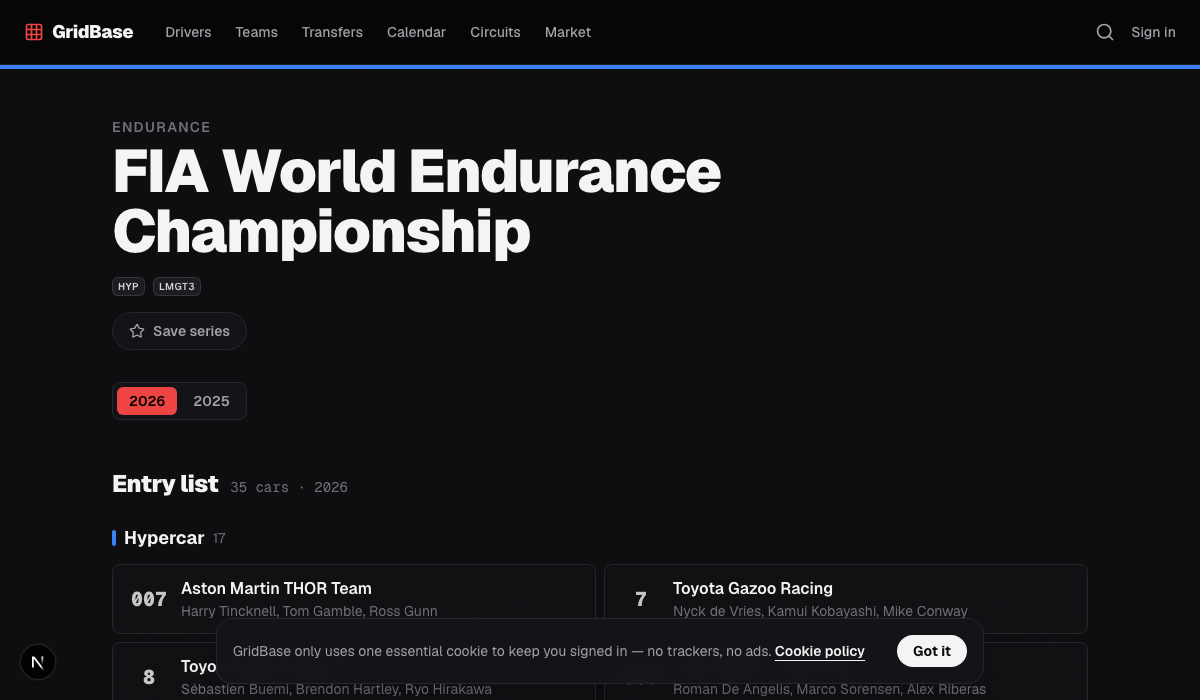
Eight-plus manufacturers, each with multiple cars, each car with three drivers: the Hypercar class alone employs more than fifty of the world’s best professionals. Browse them all in the WEC driver listings.
Driver crews: three per car, and every one matters
Endurance racing’s deepest structural difference from single-seaters: each car is shared by three drivers, taking turns through the race in stints of roughly 40 minutes to an hour (fuel defines a stint; regulations cap total driving time per driver).
How crews are built
- The qualifier, outright one-lap speed for track position.
- The metronome, relentless consistency; the driver whose triple stint at 3 a.m. never varies by more than a tenth.
- The closer, racecraft and nerve for restarts, traffic and the final hour.
Many Hypercar drivers are ex-single-seater talents who found endurance racing’s meritocracy more welcoming than F1’s 22-seat bottleneck, a career route we map in how to become a racing driver. Others rose through GT racing (the GT3 world is the class’s biggest feeder), and a few are pure prototype lifers.
Driver ratings and the pro-am boundary
Unlike Hypercar, WEC’s lower classes use the FIA’s driver categorisation system. Platinum, Gold, Silver, Bronze, to balance professional and amateur line-ups. Hypercar crews are effectively all-Platinum territory, but the ratings still matter across the paddock, and they’re central to how GridBase prices endurance drivers in fantasy. The full system gets its own guide: WEC driver ratings explained.
A Hypercar race, hour by hour
The start is genuinely chaotic by design: Hypercars start ahead but immediately hit traffic, the LMP2 and GT cars sharing the track. Multi-class traffic management is the sport’s signature skill; a Hypercar laps a GT car every couple of minutes, every pass a small risk calculation at 300 km/h.
The middle hours are strategy chess. Stint energy allowances (that BoP lever again) define pit windows; teams position their fastest drivers against rivals’ amateurs-in-traffic phases; full-course yellows and safety cars shuffle everything, and a race can be won by pitting thirty seconds before one.
The final hour compresses everything: fuel margins calculated to the lap, tyre offsets from divergent strategies converging, and, more often than any other top category, two or three cars from different manufacturers within pit-stop distance of the lead.
Multiply by four for Le Mans, add night, add weather, add 60+ cars, and you have the discipline’s Everest.
Why Hypercar matters beyond WEC
- It re-anchored Le Mans. The world’s greatest race needed a top class worthy of it; Hypercar delivered the deepest fields in decades and centenary-era editions that instantly entered folklore.
- It gave manufacturers an F1 alternative. A works Hypercar programme costs a fraction of an F1 team and can win the race. For boards choosing where racing budgets go, that math changed everything.
- It created a driver market renaissance. Dozens of top-tier professional seats now exist outside F1, with salaries, factory status and Le Mans glory attached. Watch how often F1’s transfer market casualties resurface in endurance within a season.
- It made fantasy endurance viable. With this much manufacturer parity, picking WEC winners is genuinely hard, which is exactly what makes the fantasy market’s WEC tier fun.
How we got here: from Group C to Hypercar
The Hypercar class makes more sense when you know what it was built to avoid. Top-class sports car racing has lived through a boom-and-bust cycle roughly every fifteen years, and each bust taught the rule-makers something.
The Group C golden age (1982–1992) is the era every fan over fifty measures everything against: Porsche 956s and 962s, Jaguar and Sauber-Mercedes, grids of forty prototypes, and a fuel-allocation formula that encouraged wild engineering diversity. It died the way these eras always die, a rules pivot (toward expensive 3.5-litre F1-derived engines) sent costs vertical, manufacturers walked, and by 1993 the world championship itself had collapsed. Lesson one: cost kills categories, not lack of interest.
The LMP1 hybrid era (2012–2017) produced arguably the most sophisticated racing cars ever built. Audi’s diesel hybrids, Porsche’s 919, Toyota’s TS050, machines whose hybrid systems previewed road technology by a decade. It also cost each manufacturer sums comparable to an F1 programme, for a fraction of the audience. When Audi left and Porsche followed, Toyota was left racing itself at Le Mans. Lesson two: a class that needs three manufacturers to be credible cannot survive on engineering prestige alone.
The Hypercar rules, drafted in the ashes of LMP1, were therefore written backwards from a budget: pick a cost target a marketing department can defend (roughly a quarter of LMP1 spending), then design the maximum spectacle achievable inside it. Slower cars, standardised hybrid parts on one platform, BoP to keep engineering arms races pointless, every unglamorous compromise traces back to those two lessons. Eight manufacturers on the 2026 grid is the compromise’s vindication.
The supporting cast: LMP2 and LMGT3
You can’t read a WEC race without understanding the classes sharing the track, because multi-class traffic decides races at the front.
LMP2 is the professional-amateur prototype class: identical Oreca-dominated chassis, spec engines, and crews mixing young professionals (often the next generation of Hypercar stars, check how many current factory drivers have LMP2 titles on their GridBase profiles) with gentleman drivers who fund the programmes. LMP2 cars run a few seconds off Hypercar pace, which means a Hypercar closes on one at ten seconds a minute in traffic, every encounter a judgement call.
LMGT3 brings the production-based machinery, Ferraris, Porsches, Corvettes, Aston Martins, McLarens built to the GT3 rulebook that dominates global sports car racing, with mandatory Bronze-rated amateurs in every crew (the driver rating system exists substantially for this class). GT3 cars are thirty-plus seconds a lap slower than Hypercars at Le Mans; lapping them cleanly, hour after hour, in darkness and rain, is where 24-hour races are quietly won and lost.
The three-class structure isn’t legacy clutter, it’s the business model. Amateur-funded classes pay a large share of the paddock’s bills, fill the grid to spectacle-density, and provide the traffic complexity that makes endurance racing a different sport from sprint racing rather than merely a longer one.
The qualifying format tops off the fan toolkit: WEC uses Hyperpole, a two-stage shootout where each class’s fastest cars from a first session advance to a single-lap-style showdown. It matters less than in sprint racing (a 6-hour race forgives grid slots) and Le Mans pole remains one of the sport’s cherished honours anyway, the lap records set in Hyperpole trim are the fastest this circuit generation will ever see.
Inside a Hypercar team’s race week
The operational scale is worth appreciating, because it explains why manufacturers treat WEC as seriously as F1.
A two-car Hypercar effort travels with 60–100 people: six race drivers plus reserves, a race engineer and performance engineer per car, systems engineers for the hybrid powertrain, tyre specialists working with Michelin’s allocation system, strategists running simulation software continuously through the race, and mechanics drilled for brake changes, a routine 24-hour-race operation that F1 never faces, in under five minutes.
The strategic layer dwarfs sprint racing. A six-hour race involves roughly 28 pit stops across two cars, each a decision node: fuel only or fuel-plus-tyres, double-stint the compound or take fresh rubber, driver change now or extend the stint to hit a traffic window. Teams model rivals’ fuel states from their pit timing and adjust in real time. At Le Mans, add tyre allocations spanning day-night temperature swings of twenty degrees, driver fatigue management across three time zones’ worth of racing, and reliability calculus, how hard to lean on an engine that must survive 385 laps.
This depth is why ex-F1 strategists increasingly populate WEC pit walls, and why the discipline’s best teams are studied as organisational case studies well beyond motorsport.
Following the class as a fan (and a fantasy manager)
The season shape. WEC runs roughly eight rounds: a Middle East opener, the classics (Spa, Le Mans), and a global tail through the Americas and Asia. Everything orbits June. Le Mans counts for extra points and infinitely more prestige. Track the full schedule on the WEC series page.
How to watch a 6-hour race without six hours. Watch the first forty minutes (start chaos plus first stops), sample the middle on a second screen with a lap chart, and clear your schedule for the final ninety minutes, which decide everything. For Le Mans, the non-negotiables are the start, dusk, dawn and the last two hours.
Reading the timing screen. Ignore raw gaps; watch stint-by-stint averages and pit cycles. A car 40 seconds behind but one stop ahead is leading. Every WEC broadcast assumes you know this; now you do.
Fantasy angles. In the fantasy motorsport games, WEC pricing rewards crew-reading: Platinum-rated factory drivers at top teams carry S-tier prices, but value hides in strong Silver-rated drivers in competitive crews and in factory juniors doing double duty across series, the market’s multi-series bonus quietly flags them. Our pricing explainer covers the mechanics.
The names to know first. Start with the reference drivers each manufacturer builds around, the metronomes with five-plus seasons of career entries in the database, then learn the young chargers arriving from LMP2 and GT ranks each season. Within a season of watching, you’ll have favourites in every garage; endurance racing’s three-drivers-per-car structure means you get to know crews, and crews have chemistry that single-seater racing simply doesn’t show you.
Hypercar vs Formula 1: two definitions of “fastest”
On raw pace, there’s no contest: around a lap of Spa, a Formula 1 car is 20–30 seconds faster than a Hypercar. F1 cars weigh roughly 250 kg less, carry double the downforce, and are built to be at maximum performance for two hours. But flip the metric and the contest inverts. A Hypercar’s mission profile, 24 hours at racing speed, is something no F1 car has ever been asked to survive. Le Mans distance exceeds 5,000 km; a full F1 season of grands prix totals roughly the same. Brake discs, gearboxes and hybrid systems that must live that long are a fundamentally different engineering problem than components changed between Saturday and Sunday.
The disciplines diverge in driver demands too. An F1 driver races alone, in daylight or under floodlights, on a track occupied only by 21 identical-speed rivals. A Hypercar driver shares his car with two others whose setup compromises he must absorb, races through genuine night with 300 km/h closing speeds on amateur-driven GT traffic, and hands over a machine that must remain perfect for the teammate at 4 a.m. Many drivers have done both at the top level; nearly all describe them as different sports that happen to share physics.
The honest summary: F1 optimises the peak; endurance optimises the integral. Motorsport is lucky to have both, and, as the number of ex-F1 names on WEC entry lists shows, the drivers increasingly refuse to choose.
Five questions that will define the class’s next years
- Grid caps and quality control. Success created a queue: more manufacturers want in than the paddock can physically host alongside LMP2 and LMGT3. How the ACO allocates entries, and whether privateer Hypercars get real support, will shape the class’s character.
- BoP transparency. The governing bodies have moved toward more algorithmic, data-driven BoP. Manufacturers publicly support the principle and privately lobby the parameters. A major BoP controversy at the wrong moment remains the class’s biggest reputational risk.
- Hydrogen on the horizon. The ACO has signalled a hydrogen class for the future of Le Mans. Whether it arrives as scheduled, and whether the current manufacturers bridge into it, is the long game every strategy department is modelling.
- The IMSA convergence question. LMDh already lets cars cross the Atlantic; fans increasingly ask whether the championships themselves should converge further. Both paddocks say no, their differences are the point, but the commercial pull is real.
- Driver market inflation. With eight-plus factories bidding for a limited pool of proven endurance aces, seat prices are rising, and multi-year factory contracts are back. Watch the transfer market each winter: the Hypercar silly season is becoming as intricate as F1’s.
Go deeper: every WEC entry and crew in the database, the beginner’s guide to Le Mans, and current Hypercar driver prices on the fantasy market.
Check what you just learned. No stakes, no timer.
Sources
FAQ
What does Hypercar mean in WEC?
Hypercar is the top class of the FIA World Endurance Championship, the prototypes that compete for overall victory in every race including the 24 Hours of Le Mans. It replaced LMP1 in 2021 and includes cars built to either LMH or LMDh regulations, balanced against each other by Balance of Performance.
What is the difference between LMH and LMDh?
LMH (Le Mans Hypercar) lets a manufacturer design the entire car, including an optional front-axle hybrid, the route chosen by Toyota, Ferrari, Peugeot and Aston Martin. LMDh (Le Mans Daytona h) uses a standardised chassis from an approved supplier and a spec rear-axle hybrid, costs less, and is eligible for both WEC and IMSA, the route chosen by Porsche, Cadillac, BMW and Alpine.
What is Balance of Performance (BoP)?
BoP is the system of per-car adjustments, minimum weight, maximum power and stint energy, that lets different Hypercar designs compete equally. It is recalculated for each event from performance data. It exists because without it, merging two rulebooks into one class would be impossible.
How many drivers share a WEC Hypercar?
Three drivers per car, rotating through stints of roughly 40–60 minutes, with regulations limiting each driver’s total time. Crews are built to balance qualifying speed, night-stint consistency and race-closing craft.
Which manufacturers race in Hypercar in 2026?
The 2026 class features Toyota, Ferrari (AF Corse), Porsche (Penske), Cadillac, BMW (Team WRT), Aston Martin (THOR Team), Peugeot and Alpine, the deepest manufacturer field in top-class endurance racing since the 1960s.
Is a Hypercar faster than an F1 car?
No, an F1 car is roughly 20–30 seconds a lap faster around a circuit like Spa. Hypercars trade single-lap pace for 24-hour durability, traffic management across multiple classes, and multi-driver operation. Different sport, deliberately.